Railway photography is both a historical record and an art form — a way of freezing a moment in time while capturing atmosphere, memory and emotion. For photographer Chris Gee, it is also about recreating the feel of the past, particularly the early 1980s, by carefully composing images that could plausibly have been taken decades ago.
That challenge is harder than it sounds. Modern infrastructure, contemporary rolling stock details and present-day surroundings constantly threaten the illusion. Achieving authenticity requires the right locomotive, a sympathetic backdrop, tight composition and a willingness to accept compromise. The goal is never perfection — but to get close enough that the image feels right.
Gee has long been drawn to the British Rail Class 37/4, both for its iconic design and for the refurbishment programme that extended the life of these locomotives. When first rebuilt, the class emerged in British Rail ‘large logo’ blue, a livery he considers one of the best BR ever produced: simple, bold and highly photogenic.
From the history of steam through to 21st century rail transport news, we have titles that cater for all rail enthusiasts. Covering diesels, modelling, steam and modern railways, check out our range of magazines and fantastic subscription offers.
The ‘large logo’ style itself evolved from late-1970s depot experiments that sought to break up the monotony of BR corporate blue. Stratford, Finsbury Park and Eastfield were early innovators, before the first officially sanctioned large-logo repaint appeared on a Class 56 in 1978. The look soon spread, with Class 47 47170 County of Norfolk following, and Eastfield’s 37111 and 37112 introducing wrap-around yellow ends in April 1981 — early steps toward a livery that would define the era.
By the mid-1980s, Gee was regularly visiting BREL Crewe Works, where the Class 37/4 refurbishment programme was in full swing. Locomotives were fitted with electric train supply, rewired, regeared with CP7 bogies and upgraded with a Brush alternator. Freshly outshopped in large-logo blue, they were an unforgettable sight in the sunshine by the traverser.
These locomotives soon became familiar across Scotland, particularly on the West Highland Line, at Eastfield and Inverness depots, and on the Far North Line to Wick and Thurso. Although they appeared elsewhere — including the Cambrian Coast — it was Scotland where the class truly left its mark.
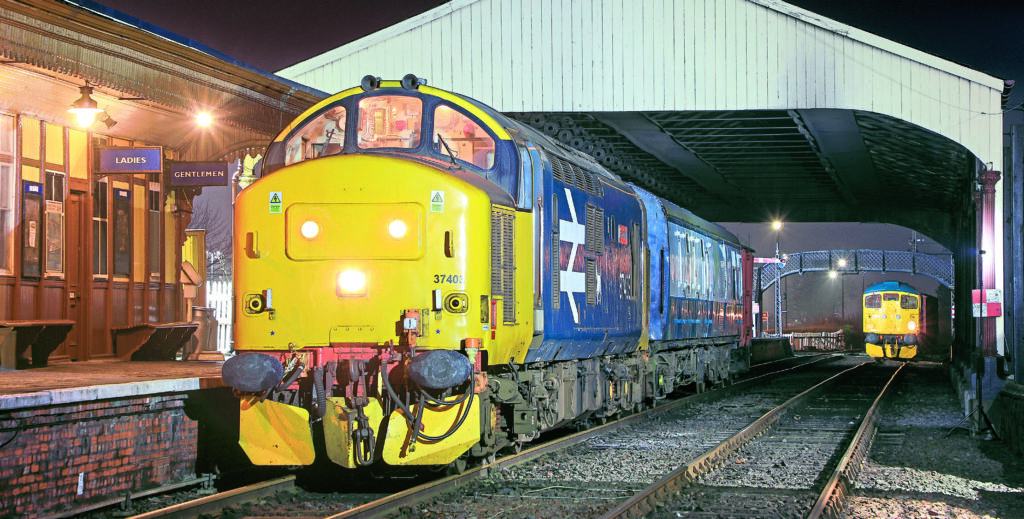
An opportunity to recreate that era came during a photographic charter at the Bo’ness and Kinneil Railway. While much of the day focused on Class 26 traction, the evening shoot allowed for two carefully staged cameos — including 37403 Isle of Mull posed beneath the station trainshed at Bo’ness with a blue-and-grey courier van.
The scene deliberately echoed daily Class 37/4 workings at Wick and Thurso between 1986 and 1989. Although compromises were inevitable, the details align closely with history. Locomotive 37403 was rebuilt from 37307 at Crewe Works between October 1984 and June 1985, named Isle of Mull in January 1986, and later renamed Glendarroch in November 1988 — making the recreation authentic to that specific window in time.
While the locomotive did not reach Wick or Thurso in passenger service until 1990 — by which point it wore Railfreight Distribution grey — the photograph succeeds in capturing the spirit of the era. Under the trainshed roof at Bo’ness, time briefly slips back to the late 1980s, as if a northbound service has just arrived and shunting duties await.
Mission accomplished.
Original article by Chris Gee appeared in Railways Illustrated. To subscribe please visit https://www.classicmagazines.co.uk/railways-illustrated