Sixty years ago, Sunderland was in the midst of one of the most significant railway redevelopments in its history, as British Railways’ North Eastern Region completed a major modernisation of Sunderland Central Station.
An article published in the January 1966 issue of The Railway Magazine detailed how decades of incremental change culminated in the opening of a thoroughly modern station, designed to meet the demands of post-war rail travel and urban redevelopment.
From Moor Station to Sunderland Central
Rail services first reached Sunderland in 1836, when the Durham & Sunderland Railway opened a terminus near South Dock known as Town Moor Station. This was replaced in 1858 by Hendon Station, located half a mile to the south, at the junction of the Newcastle & Darlington Railway and the Penshaw & Durham line.
From the history of steam through to 21st century rail transport news, we have titles that cater for all rail enthusiasts. Covering diesels, modelling, steam and modern railways, check out our range of magazines and fantastic subscription offers.
Further change followed in 1879, when the North Eastern Railway opened a new line from Ryhope Grange Junction and built a station on the present site. Hendon and Fawcett Street stations were closed, and the new facility officially opened as Sunderland Central. From the outset, the station featured cutting-running platforms aligned north–south, bounded by retaining walls to the east and west, with a single street-level entrance at the north end.
Wartime damage and post-war repairs
The station suffered bomb damage in 1943, affecting both the roof and the north-end buildings. Temporary repairs followed, and in 1953 the original arch roof was replaced with umbrella-style roofing. The south-end buildings also received an interim refurbishment during this period.
A fully rebuilt station emerges
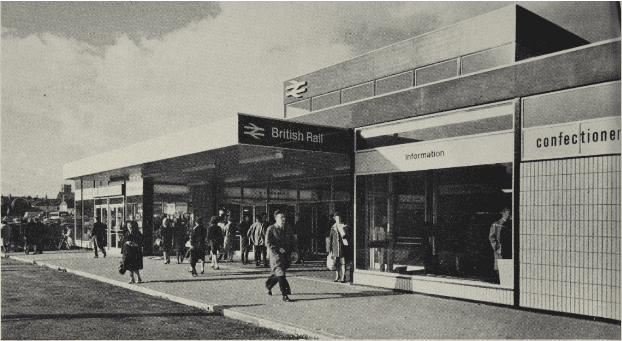
By the mid-1960s, British Railways undertook a comprehensive rebuilding scheme covering almost the entire station site. New station buildings officially opened on November 4, marking the culmination of the project.
At the south end of the station, a two-storey block of 20 shops, developed by City & Central Shops Ltd, formed the commercial heart of the redevelopment. Older station buildings at the north end remained in use while demolition and construction progressed.
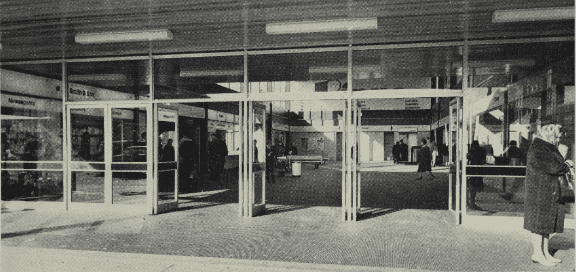
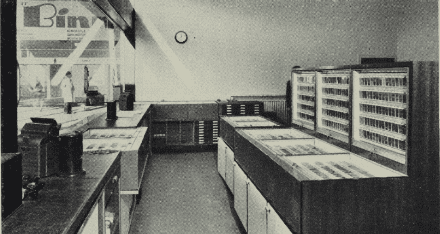
The rebuilt concourse incorporated modern facilities including ticket offices, waiting rooms, refreshment areas, lavatories, a public bar, tobacconist and retail units. The concourse was illuminated by fluorescent lighting, with passenger information provided through illuminated departure displays and a public address system serving the concourse, refreshment areas and platforms.
Modern platforms and operations
Two island platforms were retained, though local stopping services were withdrawn. Passenger services were concentrated on one platform, while the second was allocated to parcels traffic.
The station’s construction made extensive use of reinforced concrete and steel decking, with buildings finished in steel-framed panels, glass, and white frosted tiles. Ceilings throughout the concourse and shop areas were completed in patterned finishes or plasterboard.
Signalling was also modernised, with control transferred to a new light signalling installation connected to Burdon Dock signal box. The system incorporated colour-light signals, subsidiary signals, all-electric point machines and multiple track circuits.
Wider urban improvements
The station redevelopment enabled wider changes to Sunderland’s city centre. These included the widening of Station Street and parts of Union Street, the creation of a 15-foot pedestrian thoroughfare linking Union Street and St Thomas Street, and the widening of Athenaeum Street to form a forecourt for station buildings.
Provision was made for motor vehicles to set down and pick up passengers without disrupting pedestrian flows, reflecting the changing patterns of transport use in the 1960s.
A milestone in Sunderland’s railway history
Looking back 60 years on, the transformation of Sunderland Central Station stands as a clear example of how Britain’s railways adapted to post-war travel needs — blending modern architecture, improved passenger facilities and integrated urban planning into a single redevelopment.