Small, characterful and often overlooked, British Rail’s Class 03 shunters played a vital role across the network, quietly breaking up the visual and operational monotony of the more numerous Class 08s. Though diminutive in stature, the 03s proved themselves to be remarkably capable machines and became a familiar sight in yards, docks and stations across the country.
The Class 03 was a successful design, with 230 locomotives built at Swindon and Doncaster Works. Given the changing nature of Britain’s railways through the 1980s, it is striking how long the class survived. The final British Rail-owned examples were withdrawn at Birkenhead in 1989, discounting later survivors on the Isle of Wight and at Hornsey depot.
When the author began serious railway observation in 1980, there were still 58 Class 03s in main line service. By that stage, the type was firmly concentrated on the Eastern and Western Regions, although a notable exception would later emerge.
From the history of steam through to 21st century rail transport news, we have titles that cater for all rail enthusiasts. Covering diesels, modelling, steam and modern railways, check out our range of magazines and fantastic subscription offers.
Eastern and Western strongholds
Growing up in Salford, the nearest Class 03s were those allocated to Birkenhead Docks, where they appeared from November 1981, working either within the dock estate or stabled at Birkenhead Mollington Street.
Further afield, the North East offered rich pickings. Gateshead-allocated locomotives could be found at the depot itself, as far north as Berwick-upon-Tweed, or working locations such as Tyne Yard, Low Fell Yard, Tyneside Central Freight Depot and Newcastle Central Station. Darlington-based examples worked Dinsdale permanent way yard and Etherley Tip, while York-allocated machines appeared at York MPD and Scarborough station.
Elsewhere in Yorkshire, Class 03s were based at Hull Botanic Gardens, Bradford Hammerton Street (often seen at Bradford Interchange), and there was even a survivor at Barrow Hill.
East Anglia was another hotspot. Colchester-based locomotives worked Ipswich, while Norwich allocations handled shunting duties around Norwich Thorpe. Additional sightings could be made at Lincoln, Boston Docks, March depot, King’s Lynn docks, and latterly Stratford depot. Eastern Region Class 03s were almost always paired with a match truck, ensuring reliable operation of track circuits due to their short wheelbase.
On the Western Region, the remaining BR fleet was concentrated in South Wales, all allocated to Landore. These locomotives were fitted with cut-down cabs for work on the Burry Port and Gwendraeth Valley Railway, and could regularly be found at Landore depot, Llanelli, or Burry Port. The only exceptions were 03121 and 03382, which survived allocated to Bristol Bath Road for local shunting.
Beyond British Rail
By the mid-1980s, all BR-owned Class 03s had been seen, but many examples continued to work in industrial service. Tracking these down led to visits across the country — to scrapyards, rolling mills, coal depots, car plants and salt works — including locations such as Willesden, Queenborough, Dagenham, Middlewich, Crigglestone, Monkton, Lenwade and Bridgwater.
A number of Class 03s were also exported, though these proved harder to follow, with the exception of the pair that went to the Isle of Wight. Thankfully, several exported examples have since been repatriated and can now be seen on heritage railways.
Another reliable place to find Class 03s in the 1980s was at BREL Doncaster and Swindon Works, both familiar with the type after building them and continuing to carry out classified overhauls and repairs.
A reunion decades later
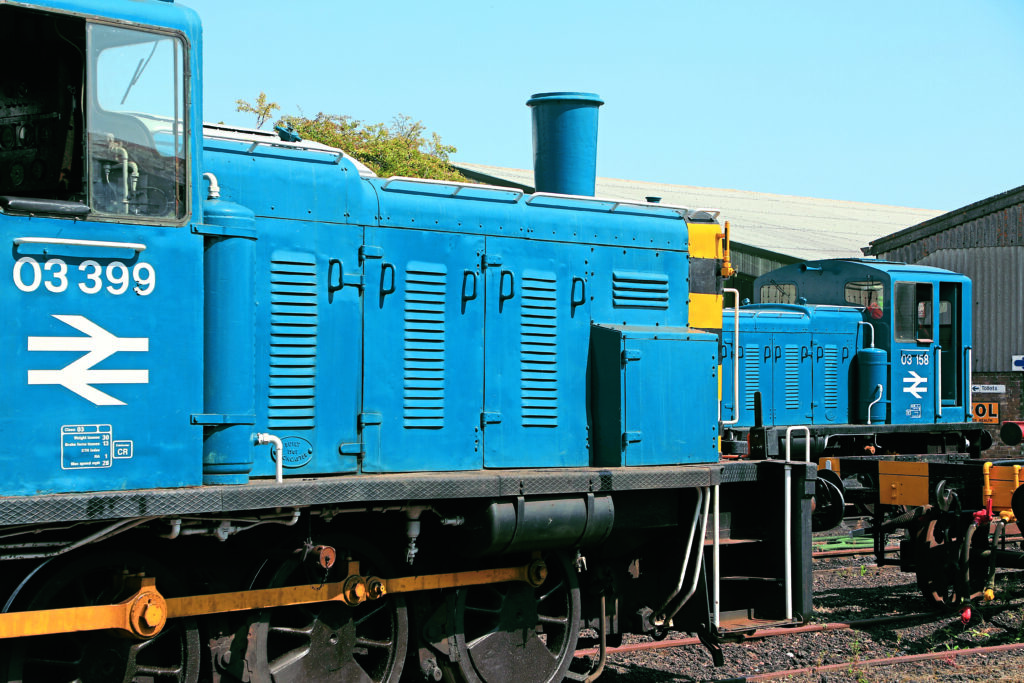
On October 31, 1982, a visit to Doncaster Works yielded two Eastern Region machines: 03158 (Norwich) and 03399 (Colchester).
Locomotive 03158, dual-braked in spring 1968, underwent a classified overhaul at Doncaster in September–October 1981, returning to Norwich in early 1982. Persistent issues saw it back at Doncaster by October 1982, where it remained for much of the following year before returning to Norwich. It was finally withdrawn in July 1987.
Similarly, 03399 received a classified repair in spring/summer 1979, returned again to Doncaster in summer 1982, and remained there until late in the year before heading back to Norwich. Like its classmate, it was withdrawn in July 1987.
Fast forward more than four decades, and the pair were reunited once again — this time preserved — at the Mangapps Railway Museum during its August diesel gala. On August 24, 03158 and 03399 basked in the late-afternoon sunshine, evoking memories of Doncaster Works all those years earlier, waiting patiently for release back to their home depots.
For anyone who remembers them in service, it was a moment that perfectly captured the quiet charm and enduring appeal of the Class 03.
Original article appeared in Railways Illustrated. To subscribe please visit https://www.classicmagazines.co.uk/railways-illustrated