A recent round-up of restoration projects as seen in Railways Illustrated Magazine, compiled by Pip Dunn.
03145 – Moreton Park: In September, the reduced-height 03 received a layer of polish from the top down to give it some protection during the winter. Some rust spots on the cab end and sides were treated and a layer of primer applied in preparation for some touch-up painting. The coupling rods and bufferbeams also received some rubbing down, filling, and priming.
A few weeks later, when the loco was needed for shunting, failed batteries meant it wouldn’t turn over. The batteries were known to be on borrowed time, as they’d been on it since 2014, so they were swapped with a pair off the Class 05; once fitted, the 03 started and the shunting took place.
From the history of steam through to 21st century rail transport news, we have titles that cater for all rail enthusiasts. Covering diesels, modelling, steam and modern railways, check out our range of magazines and fantastic subscription offers.
In October, the loco received some more TLC, rubbing down and undercoating the bits that had been primed. After the recent flat batteries, the group’s electrician checked over the dynamo and found that it wasn’t producing any volts or amps at its output terminals, so it was removed for inspection.
With no obvious signs of trouble, the dynamo from D2302 was fitted and 03145 was started and checked, proving that the wiring was good. The same test was carried out on D2302 with the dynamo from 03145 and the test confirmed that the dynamo was defective.
D2302 – Moreton Park: Work on the brake system has been carried out in recent months. The brake piston that had originally come off 03145 was cleaned and fitted with a new seal.
The plan was to take apart the brake cylinder, ready for the new piston, but this was met with mixed success as the team was unable to disconnect the brake piston from the brake rigging, meaning that fitting the refurbished brake piston was put on hold. It was also noted that the pipework around the compressor needed attention.
D2302 was placed over the pit to help remove a jammed brake gear pin which, once freed, was cleaned. This gave access to the brake cylinder and meant it was possible to extract the brake piston.
With this done, the source of the failure was spotted – a split piston seal. Inspection of the inside of the brake piston showed a nice, clean inner face that just needed cleaning up and some new grease applied, making it ready for the refurbished brake piston to be installed.
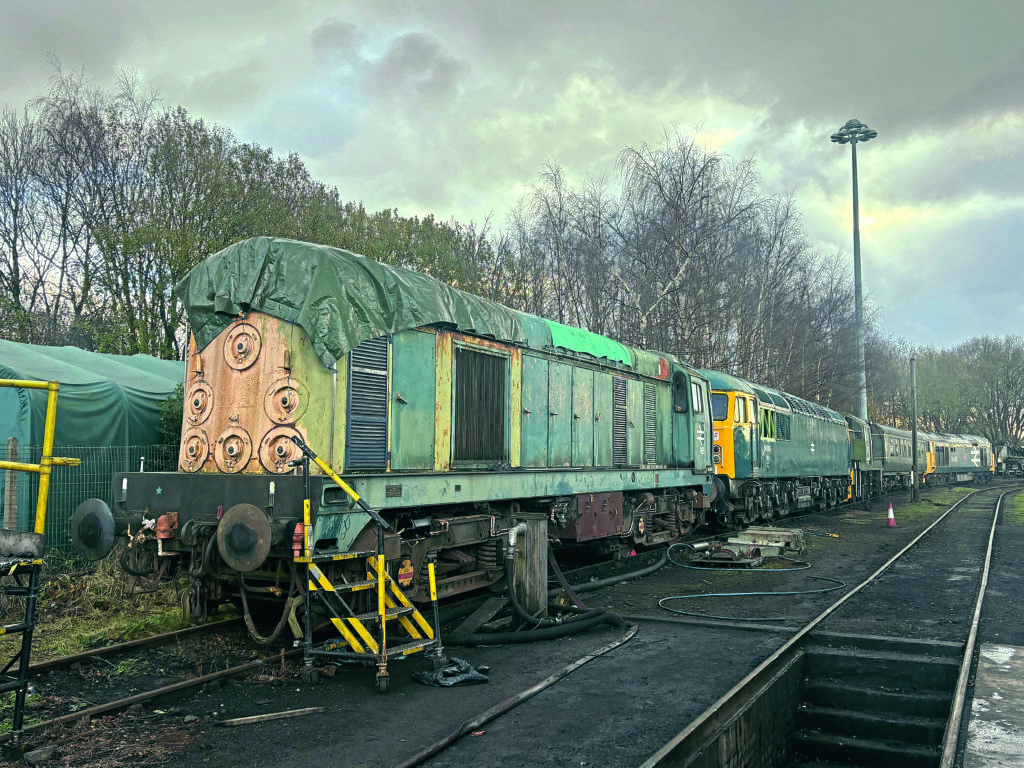
D8069 – Bury: The first week of the Bury Chopper Group’s newly-arrived Class 20 having been at the East Lancashire Railway was busy.
A small team drained the coolant system, flushing out with clean water a few times, and refilled the system with new coolant. It was discovered that the header tank gauge doesn’t work; the owners are hoping that it’s just seized and will free easily at a later date when coolant is dropped from the header.
All the crankcase doors were removed to allow inspection of the heart of the power unit, making sure all components are present – and all looks good. The power unit barred over fine.
At another working party on November 15, a start was made on cleaning the main generator and auxiliary generator, and work began in the electrical cupboard to free the reverser contactors and to give everything the once-over. Every nut in the electrical cupboard will need freeing, cleaning, and tightening back down before the loco moves under its own power.
Luckily, there were no issues with the generator, the brushes are in good condition with plenty of life, and the commutator appears to have a good chunk of copper on it as well.
Two of the retaining bolts that hold the brush tails in place snapped when an attempt was made to remove them and they couldn’t be drilled out, so the complete brush housing had to be unbolted and removed, although this then gave space to clean the commutator.
All door hinges and handles were freed. Decompressors were also refitted to the power unit. The main generator was covered and then the team moved on to the other electrical machinery. The fuel and oil pumps are both in good condition and move freely with no binding and the brushes have hardly been touched.
The exhauster isn’t wired or piped in but still the commutator and brushes needed to be checked over. Everything appears to be fine, but more will be known once the vacuum brake has been reinstated – it’s currently missing a length of pipe underneath the loco, but other things are being prioritised first.
The batteries were topped up as they were low, and they are in good condition and won’t need to be replaced anytime soon.
Moving forward, the main priority is to get the locomotive up and running, making sure it is fault-free. The bodywork and paint job is the last thing in the long-term plan, although it has been booked it in to have that work done late next year.
Now the BCG is registered as a community interest company, it is able to benefit from claiming VAT, which will go back in to the locomotive. Although it isn’t asking for donations, it has opened a PayPal account to start accepting them and 100% of donations go into the upkeep and maintenance of the loco; the button can be found on the website 20069.co.uk.
25173 – Shackerstone: All bodyside and cab welding is finished, with most of it in undercoat, and some first coat gloss on cab fit out is also being worked on.
D5705 – Bury: GenElec Diesels, based near Louth, has started the work on the crank from the HSTVEE8 engine. In addition to starting the work on the crank’s journals, the main bearings have also been re-metalled.
To date, donations have contributed £5453 (33% of the target) to the Co-Bo Appeal in just over two months; however, there is still a way to go. All donations are greatly appreciated and, as ever, a like and a share on social media goes a long way to keep the momentum of the appeal going and spread across the railway community’s timelines: visit www.facebook.com/donate/652529490804088/1184200447086594
31210 – Ruddington: Although the work to finish off the restoration of the loco had been paused, it is actually in better condition than many realise, and its engine was started in late November to show its condition to a prospective purchaser. It needs a bogie swap, with donor loco 31235 due to give up its bogies for the Railfreight grey Type 2.
31435 – Embsay: The 31 was plugged into the battery charger to see what state the electrical system had been left in. After a few reconnections and a bit of fault-finding, it was possible to get all the lights working, and the fuel pump and oil priming pump ran up as well.
37714 – Loughborough: The Heavy Tractor Group has been nursing the temperamental A-bank water pump on 37714 for a while, hoping to get to the end of December before work was needed. However, the pump didn’t last and has failed.
The HTG will be fitting a replacement in the next few weeks when it’s back from overhaul, but while the loco is stopped, it does give the opportunity to check the rest of the system and put the pre-heater pump in before wiring.
37906 – Shackerstone: The cabside repanelling has been finished, new batteries have been fitted, and the Ruston-engined loco has been run up.
40106 – Bury: The loco returned to traffic at the East Lancashire Railway working Santa specials, top-and-tailing with steam traction, on November 29/30, working the southbound legs from Rawtenstall.
40106 was also planned to operate its first diesel diagram since returning to the ELR on December 27. Going forward, it will operate until the end of April when it will be withdrawn for bodywork repairs and a repaint in time to make its ex-works debut at the Summer Diesel Gala.
47401 – Swanwick: Work on the pioneer Class 47 continues in the diesel shed at Swanwick Junction. After weeks of effort, the 47401 Project has completely refurbished both of the original radiator headers.
Badly corroded steel has been replaced with newly fabricated repair sections, keeping the majority of structure original. The group of volunteers will soon begin the task of reassembling the cooler group.
Other activities also include renewing the air tanks, which have all been removed while they can be readily accessed.
D1516 – Swanwick: The 47401 Project took the opportunity to strip and paint the bogies on 47417 while it was inside the diesel shed for a few weeks.
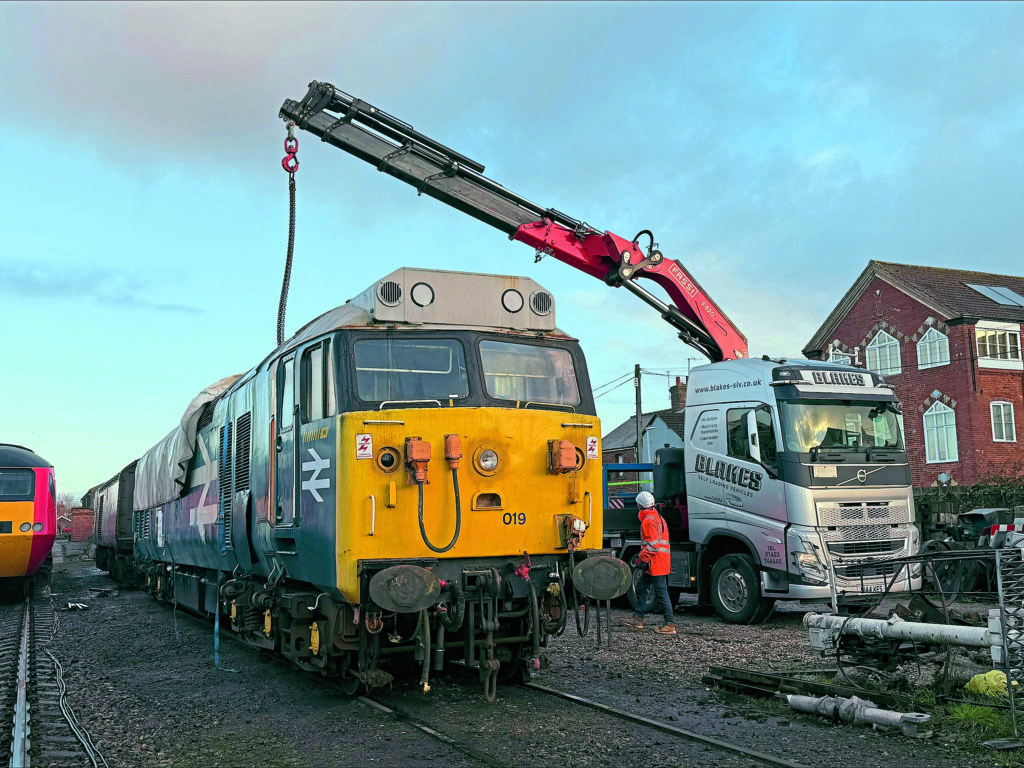
50019 – Dereham: Arrangements were made with the Mid-Norfolk Railway to have Ramillies moved to the pit road in order for the ETH and auxiliary generators set to be lifted and sent away for assessment and repair on November 15-17.
Arriving early on November 15, the group prepared the site ready for the HIAB operator from Hockering Motor Services, building a scaffold tower and removing the tarpaulin covering the roof panel over the generators. After lifting pressure was applied, the panel ‘popped’ and was successfully lifted clear of the roof and moved to an area in the yard for storage prior to restoration on the panel. This is probably the first time in 40 years that the roof panel has been off the locomotive. Once this was completed, the remaining bolts holding the generators in position were removed, ready for lifting first thing on November 17.
At 08.00, the HIAB from Blakes Haulage of Norwich arrived and, after a few checks, the generator set was lifted clear of 50019, again for the first time in many years – most certainly the biggest and heaviest lift the C50LA has carried out on the locomotive in preservation.
The generator set is being sent to Garrard Jones Engineering of Chesterfield for the work to be carried out. This is a huge milestone for the C50LA which will hopefully result in 50019 being started up towards the end of next year.
Other work has been carried out on Ramillies over the past few months includes refitting the horn tubes and horns to No. 1 cab, initial refitting of the cab ceiling and other fixtures and installing the cab timber to No. 2 cab, plus numerous other little tasks, too many to mention.
While the generator set is away, the area inside the loco will be cleaned and repainted in preparation for the return at some point in the summer. Work will also continue to restore No. 1 cab with the installation of the driver’s desk and other key parts. The C50LA has plans to fit the preheater into 50019 and is in the process of having the bogies assessed in early spring 2026.
The C50LA thanks the MNR for its assistance in enabling it to carry out the lift and also Hockering Motor Services and Blakes Haulage for helping complete this big step in returning Ramillies to traffic.
For more information, follow the 50019 Ramillies Class 50 Locomotive Association Facebook group page.
55009 – Barrow Hill: It was headline news in the heritage diesel world when the DPS undertook the first Deltic Power Unit swap back in 1984, but now it’s just another one of the multitude of tasks that the society undertakes almost as matter of course.
Naturally, it’s something that it doesn’t want to be done regularly, but when the need arises, the plan goes into action, and the job gets done quickly, efficiently and safely.
November 17 saw the team of DPS volunteers, with assistance from Merritts Machinery Logistics and Barrow Hill, undertake a power unit swap on Alycidon and, unlike September 2023 when the double power unit installation into D9015 Tulyar was completed in miserable weather, the sun shone and it was only towards the end of the day that the temperature dropped noticeably.
When PU451 failed in 55009 at the Nene Valley Railway in May 2024, work in overhauling PU430 was already well advanced and the decision was made that this would be the replacement power unit upon completion.
With 2633 running hours recorded, PU430 is one of the lowest-hour units owned by the society and last ran when fitted to 55008 The Green Howards, the loco being withdrawn on December 31, 1981, with flat batteries.
In preparation for returning to operational use, 430 has received overhauled fuel pumps and injectors, all-new coolant and oil hoses, a refurbished engine governor, and a ‘zero hours’ phasing case overhaul, along with overhauled main and auxiliary generators. The total cost for all this is in the region of £45,000.
The same work is being undertaken on the society’s other low-hours power unit, 423, which last ran in 1981 while fitted to 55007 Pinza.
A GoFundme appeal is being run to help finance this power unit overhaul. Every pound raised goes directly to the overhaul costs: https://gofund.me/d8ee09371