From the February 1983 issue of The Railway Magazine, this report records the completion of the first of 35 Class “58” diesel-alternator locomotives at Doncaster Works. It details their design development, technical specification, testing programme and early performance figures.
Order and Background
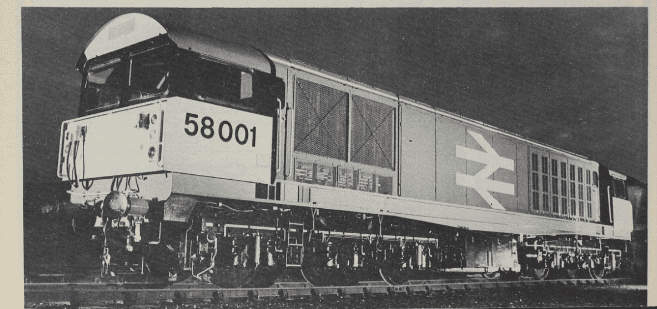
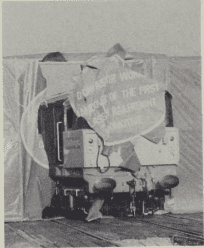
ON December 9 at Doncaster Works, Philip Norman, Managing Director of British Rail Engineering Limited (BREL), formally handed over the first 3,300-h.p. class “58” diesel-alternator locomotive, No. 58 001, to Henry Sanderson, Director, Freight, British Railways Board. This is the first of an order for 35 locomotives, costing approximately £800,000 each (about 13 per cent. less than a class “56”), which are being built at BREL, Doncaster. No. 58 001 is finished in the grey and red livery used on BR’s “Speedlink” air-braked freight vehicles (grey body, red underframe, black bogies, and yellow cab ends and sides), with the word “Railfreight” on one cab side and the locomotive number on the other.
Genesis of the design goes back to 1977 when BREL requested BR’s Locomotive Design Office to prepare a report and design feasibility study on a low-cost 2,500-h.p. locomotive for export markets. The class “58” has been developed to combine the lower costs and better maintenance access features of the export locomotive design with the successfully proven basic specification and power equipment of the class “56”.
From the history of steam through to 21st century rail transport news, we have titles that cater for all rail enthusiasts. Covering diesels, modelling, steam and modern railways, check out our range of magazines and fantastic subscription offers.
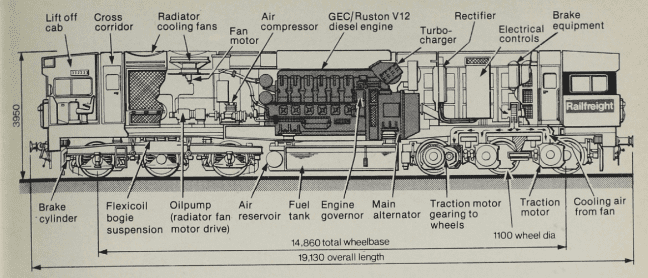
Underframe of the class “58” is basically two fabricated deep girders of I-section running the headstock to headstock and supporting the bonnet and cabs. In addition to being designed to withstand the required end loading of 200 tons at buffer height, the underframe will carry all the static loads imposed by the equipment and those arising from dynamic forces when the locomotive is in operation. It will also allow lifting of the complete locomotive by the bogie centre pivots without permanent deformation of the members. The tops of the girders form platforms for maintenance staff attending to the engine, alternators and auxiliaries.
Body, Cab and Access
The bodysides are of a “bonnet” type with access doors to equipment compartments. A continuously welded sealing plate prevents waste spillage leaking onto the bogies; this plate drains into a sump beneath the diesel engine. There are four removable roof sections giving access for removal of equipment.
Between the driving cabs is the bonnet, which is divided into four sections housing: radiator equipment and one electrically-driven traction motor blower; power unit and compressors; turbo-charger air inlet and electrical equipment; and electrical control equipment cabinet, main rectifier, the second traction motor blower and the brake equipment.
Driving cabs at each end of the locomotive are insulated against heat and sound. Inside, on the left-hand side, is the driver’s seat, with a seat for the assistant on the right. On the righthand side of the driver is a new form of power controller mounted on a pedestal fixed to the floor. The brake controller, on the driver’s left, is arranged like a tiny “joystick” giving gradual application and release. This controls the auto air brake by energising any of three wires in a sequence corresponding to a predetermined brake demand. For an emergency application, all control wires are de-energised. There are two air horns at each end of the locomotive, one with a high note and one with a low, each note being operated separately.
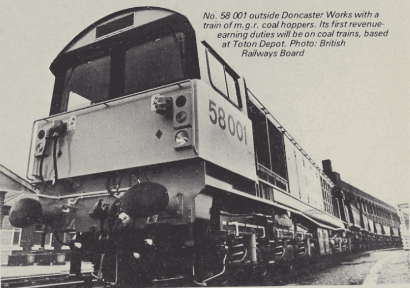
The cab is heated and provided with a boiling ring. The vertical front windscreen is divided by a central pillar into two flat panes of high-impact glass with built-in electric heating. Air-operated windscreen wipers with washers are fitted, as are adjustable sun-blinds. Sliding windows in the cab side enable driver and assistant to lean out and observe the rear of the train.
Access to the cab is from a cross-corridor behind it, in the bonnet section, with a central hinged door in the back of the cab which just clears the driver’s seat and control pedestal. The hinged doors to the cross-corridor have fixed windows and slam locks.
Bogies and Suspension
Bogies for the class “58” have been supplied by BREL Crewe and are designated “CP3”, evolved from a pair of “CP1” experimental bogies fitted to No. 56 042. Each bogie has three driven axles with monobloc wheels and the main frame is of welded construction. Primary suspension is by helical springs in the vertical plane and “silentbloc” parallel rubber bushes in the lateral/longitudinal plane. The outer axleboxes are each fitted with two roller bearings and the centre axles with cylindrical roller bearings to allow axlefloat.
Axle-hung nose-suspended Brush “TM 73-62” traction motors are fitted; these are a derivative of those used on the class “45” locomotive, the experimental 4,000-h.p. Hawker-Siddeley Kestrel and on the class “56”. They are force-ventilated from a duct system on the locomotive body, connected by flexible ducting to the motors. The motor pinion drives a solid spur wheel on the axle.
A bogie pivot pin guides rotation and transmits traction and braking forces from the bogie to the locomotive body. Secondary suspension is by two nests of three Flexicoil springs on each side, fitted into pockets in the girder underframes. Sanding is available to the outer wheels of each bogie. Direct-acting brakes have one cylinder per two blocks and two cylinders per wheel. The parking brake is applied and released hydraulically, the required pressure being generated by electrically driven pump. The parking brake operates on two wheels of one bogie and is applied by using the parking brake push-button in each cab.
Power Equipment
The diesel power unit is a Ruston “RK3ACT” charge air-cooled 12-cylinder vee engine, rated for service in the class “58” at 2,460 kW (3,300 h.p.). Speed control is operated by air pressure varied continuously by the locomotive controller. It is started by twin d.c. electric motors. At the free end of the engine is a power take-off shaft which drives the hydrostatic pump for the radiator cooling fan motors and air compressors.
Flange-mounted to the other end of the engine are the main and auxiliary alternators; the main feeds alternating current to a main rectifier which converts it to direct current for the six traction motors; these are arranged in three series pairs, except in slow speed when all six are connected in series. Each pair is switched by an electro-pneumatic contactor. The auxiliary alternator supplies a.c. to the brushless induction motors of the traction motor blowers.
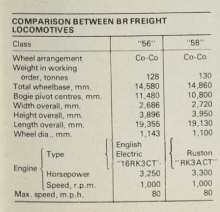
Wheel-slip detection cuts the tractive effort when wheel-slip occurs, gradually restoring it when slip ceases. Standard automatic warning system and driver’s safety devices are fitted and up to three locomotives can be coupled and driven in multiple. Each locomotive weighs 130 tonnes and can haul a 1,000-tonne train at a maximum speed of 80 m.p.h. Leading dimensions, and a comparison with those of the class “56”, are given in the table.
It was intended to complete the first two locomotives in 1982, 12 more in 1983, 17 in 1984 and the last four in 1985. Nos. 58 001/2, on completion, were due to go to Derby for further tests, track evaluation and driver training and then operational, to be based at Toton Depot, Nottingham (TO), for use on merry-go-round (m.g.r.) coal traffic, of which Railfreight hauls some 95m tonnes a year.