D. M. RHIND WHETS YOUR APPETITE AND EMPTIES YOUR WALLET WITH A RIDE ON SOUTH AFRICA’S “BLUE TRAIN”
IT’S 12 o’clock and the noon-day gun fires from Signal Hill, Cape Town, the tourists in Adderley Street say “Ooh” or “Aah,” and some of the more inexperienced pigeons in Greenmarket Square take to the air and then settle back on the cobblestones feeling a bit foolish. If it’s a Monday or a Wednesday then, at the same moment, the South African Railways 3 ft. 6 in.-gauge “Blue Train” glides quietly and unobtrusively away from Platform 24 at Cape Town Station at the start of its 998-mile journey to Pretoria. Leaving Cape Town at noon it reaches its destination at 2 p.m. the next day, having climbed from sea level to more than 5,700 feet at Johannesburg.
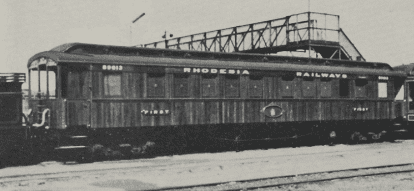
Cape Town has long been the starting point for trains which offered outstanding comfort, if not speed. As early as 1901 a Train de Luxe was built for Rhodesia Railways by Metropolitan-Cammell Carriage, Wagon & Finance Co. Ltd. and was used between Cape Town and Bulawayo and for special excursions from Cape Town to Victoria Falls. At one time it was known as the “Zambesi Express”. The train consisted of three sleeping cars, two dining cars, two smoking and buffet cars and a baggage and postal van. The sleeping saloons cost £3,027 5s. 9d. each and had four compartments, one coupe, a wash-room, a shower bath and two lavatories; they were equipped with fans from the coach lighting system which was an innovation as it had been the general practice on the Cape Government Railways to provide electricity from a dynamo in the baggage van. The smoking, buffet and dining cars had oak panelling, and settees and chairs upholstered in dark red leather. A card room was provided as well as “a small library of handsomely bound books”.
Fares were the ordinary first class and the conductor wore a frock coat with gold braid. The “Guide to Rhodesia” published by the Beira and Mashonaland and Rhodesia Railways in 1914 offered special rates to the Victoria Falls from London for £89 5s, first class, which includes rail from London to Southampton, berth in mail steamer (main deck accommodation) to Cape Town; rail direct to Victoria Falls, via Kimberley, and return via Mafeking, Johannesburg, Pretoria, Bloemfontein, meals, bedding, and attendance included; with a stay of one week at the Falls!
From the history of steam through to 21st century rail transport news, we have titles that cater for all rail enthusiasts. Covering diesels, modelling, steam and modern railways, check out our range of magazines and fantastic subscription offers.
There were a number of named trains running at this period, such as the “Diamond Express” to Kimberley, an “Imperial Mail” and an “African Express”; just as there were a number of different railway companies and administrations. Those which were brought together by Union in 1910 to form the South African Railways & Harbours (now recently re-titled South African Transport Services) were the Cape Government Railways, the Natal Government Railways and the Central South African Railways, and it was natural therefore when a new luxury train was introduced in November 1923 between Johannesburg and Cape Town that it should be called the “Union Limited” from Johannesburg to Cape Town and the “Union Express” in the other direction.
These trains consisted of six clerestory-roofed coaches, built originally for the CSAR by the Metropolitan Amalgamated Railway Carriage & Wagon Company in 1903, which had oak and mahogany panelling, electric light and bells, train heating, and hot and cold water in the bathrooms. As the years went by additional coaches were added to the trains and new stock obtained from overseas. Among this was a dining car, built by Metropolitan-Cammell and named Umhlatuzi, which together with a kitchen car, a balcony saloon coach, a van and a class “1E” electric locomotive formed a four-car train which was parked alongside a mock platform at the Empire Exhibition at Wembley, in England, during 1924-25. During this period the dining car was staffed by SAR personnel who served thousands of typical South African meals to visitors to the exhibition. Afterwards the name of the dining car was changed to Wembley and a plaque commemorating its service at the exhibition was affixed to the inside of the carriage, which remained in service for more than 45 years.
In 1927 articulated saloons were introduced on the “Union Express” and “Union Limited” which had the then standard wooden bodies but each pair was carried on three bogies. They were luxuriously fitted with hot and cold water, bunk lights, water decanters and an electric bell system to call attendants who were in touch with the dining car by telephone. The coupes were larger than usual in that they had a large folding table and an extra seat facing the bunk.
The fare on these trains was first class plus 50 per cent. and they deposited passengers for the mail ships, and their massive cabin trunks which were a prerequisite for overseas travel in those days, on the quay alongside their ship. The ships left every Friday and took 12 days for the voyage to Southampton—today, in this container age, sea mail takes two months for the same journey. Passengers arriving at Cape Town could book their tickets on the “Union Express” while still at sea and on arrival had to take only a few steps from the bottom of the gangplank to the train.
In February 1930 a new dining car named Pretoria was placed in service on the “Unions”, which had a blue and cream livery and then in July 1937 an order was placed with Metro-Cammell of Birmingham for 12 luxury, all-steel, air-conditioned sleeping coaches costing £10,500 each. The next month a further order was placed for two all-steel, air conditioned lounge cars, two dining cars, kitchen cars, a baggage van and a reserved van. The 12 coaches were delivered during the thirties in 1940 as the “Union Limited” and the “Union Express”, also had blue and cream livery and came to be known as “those blue trains”, but the service, together with all other express trains, was suspended in 1942 because of the war and the coaches were stored for the duration.
When the service was again in March 1946 these trains were officially named the “Blue Train”, and the coaches with the distinctive roof-line known as “a modified monitor roof” became well-known for the service and standard of comfort they provided. Upholstered throughout in blue leather with blue carpets on the floors, including corridors, the blue bedding and towels added to the effect. The easy-ride, anti-sway bogies, the sound-proofing of the coaches and the all the air-conditioning which enabled the windows to be kept closed out the heat, dust, smuts and smoke out of the train—making a journey on the “Blue Train” an excitingly different experience from ordinary train travel in Africa at the time. Its comfort and service established it as one of the world’s great trains at fares of £21·71 plus a supplement of £5·62 made it good value in any language.
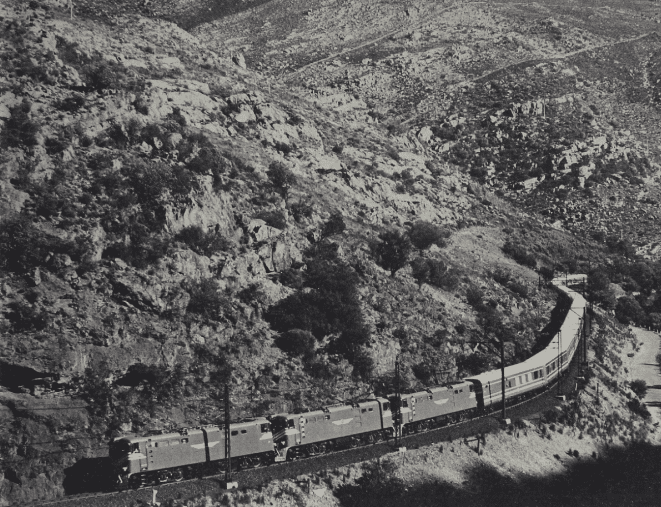
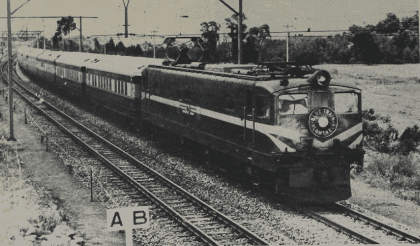
By 1967 planning had started on new equipment to replace these and the present “Blue Train”—or rather two “identical trains each of sixteen coaches—was built in South Africa by the Union Carriage & Wagon Co. Ltd. at a cost of about £2·7 million and entered service in September 1972. The old “Blue Train” stock now used on the “Drakensberg Express” between Johannesburg and Durban (487 miles) each train of the 1972 stock is triple-headed uphill by 3,340-h.p. electric locomotives operating from 3 kV overhead catenary, except for the non-electrified section between Beaufort West and Kimberley where double-headed class “34” diesel-electric locomotives take over. All the locomotives used on the train have blue and yellow livery to match the train itself. The coaches themselves, blue with white roofs, are striped in white and gold and have black running gear.
The train is equipped with air brakes, brake air being supplied from two compressors (one stand-by) in the power car. The brake system is the two-pipe graduated release type operating caliper disc brakes on all axles and to avoid possible wheel damage each axle is fitted with an electronic device which detects an incipient skid, releases the brake on that particular axle and re-applies it again when the danger of a skid is past; the total cycle time for this operation is only half a second.
This anti-skid device also controls the doors, which open sideways on the plug-door principle, and once the train speed exceeds 8 km/h (5 m.p.h.) the device automatically closes and locks any side entrance door which may have been left open and prevent it being opened again above 8 km/h and cannot be opened by any normal means, thus ensuring passenger safety.
The coaches ride on air-sprung bogies which are self-levelling; that is, they remain at the same height, irrespective of the load, and these ensure a smooth quiet ride.
Each compartment has a panel by the window to control the temperature of the air-conditioning, and one opens, closes or tilts the venetian blinds between the double glazing—the windows have a golden tint to reduce sun flare of gold is diffused and one side of the glass to deflect heat and glare. A third knob controls four channels of entertainment, while the fourth is the volume control. Train announcements also come over these channels even when the volume is turned down.
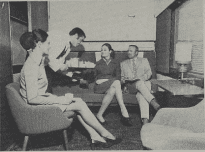
Each compartment or suite has hot and cold running water and a tap with ice-cold drinking water. Passengers can place their shoes in a locker in the compartment and they will be removed on the corridor side, cleaned and returned. There is also a bell in the compartment to call the attendant at any time; he has a telephone in his own compartment to order refreshments from the dining car or bar and he also provides a valet service. Truly it has been said that this is a five-star hotel on wheels and not just a train.
In order to provide all the comforts of a five-star hotel such as air-conditioning, full-channel stereo, subdued lighting, refrigeration, and so on, a reliable and adequate power supply was essential and this is the job of the power car which marshalled near one end of the train. Power cars have a capacity of 350 kVA and each has two diesel-alternator sets one of which works the trip in one direction while the other provides a stand-by. The sets comprise Rolls-Royce “DVB TCW” diesel engines coupled to Petbow brushless alternators. Three-phase power is transmitted throughout the length of the train on a two-line system—one from each generator, again to give 100 per cent. stand-by. Power is transformed on each coach individually from 650V three-phase to 220/380V; each coach also has a battery which is continuously charged from the main power circuit to provide emergency lighting and ventilation.
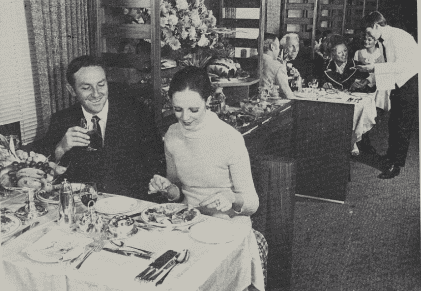
The train is made up as a set and the coaches are numbered 1 to 16 consecutively along the train so passengers have no difficulty in finding the coach in which they are booked. At the Cape Town end of the train is a baggage van and then the power car; in the centre of the train is the bar; a dining car seating 46 and the lounge car seating 34 passengers; while at the north (or Pretoria) end of the train is a composite baggage van which finishes things off neatly when it is going south.
The train accommodates 108 passengers who are served by a staff of 26 (train controller, dining-car manager, chief chef, chief stewards, stewards, bedding attendants, scullions and the two technical train personnel who supervise the power car)—or one per four passengers. It is a one-class train which offers four different types of accommodation—Type A is a three-room suite for two with a twin-bedded bedroom with wardrobe and dressing table, a full-scale bathroom and a lounge with settee, armchairs and refrigerated cocktail cabinet; Type B have a bathroom and combined bed-sitting room; Type C are double/treble berths with their own showers and w.c. as well as armchairs and tables; Type D is three-berth compartments and single-berth couples with shared shower/toilets.
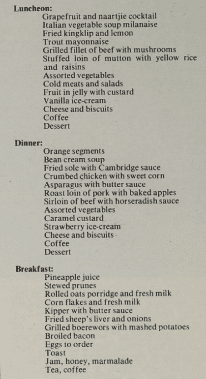
The fares are £158 for Type D, £211 for C, £241 for B and £300 for Type A (30p per mile). These compare with £65 for the normal first-class fare on the “Trans-Karoo Express”, or 90 by air. The “Blue Train” fares do, of course, include all meals and, just to show how this implies, here are the menus served on the train which left Pretoria on April 7 and arrived in Cape Town at noon on April 8, 1982:
Remember that this is no “either/or” menu and the passenger can eat the lot if he wishes and is able. (No wonder Shakespeare said “And then to breakfast, with particular joy.”) On this particular journey the Dining Car Manager was Mr. J. A. Jones and the Head Chef was Mr. J. J. Williams and their names appear proudly typed on the menu card.
To travel on the “Blue Train” one has to book several months ahead, so don’t leave it until you’re about to sail into Table Bay on the mailship (if you can find one these days); and if you can no longer do so at least trip from London for £89 is at least you can be sure that the service and the food on the train will match that of the “good old days” on the “Zambesi Express”.
The train staff say the “Blue Train” is the best in the world and I believe they’re right.
This article is available to subscribers of The Railway Magazine, along with every article from issues dating back to the 1800s! To subscribe, visit https://www.classicmagazines.co.uk/the-railway-magazine