This archive extract from The Railway Magazine revisits the 1850 proposal for the Impulsoria, a system intended to apply animal power to railway working. Reproduced verbatim, it reflects contemporary thinking on conservation, cost, and alternative locomotive methods.
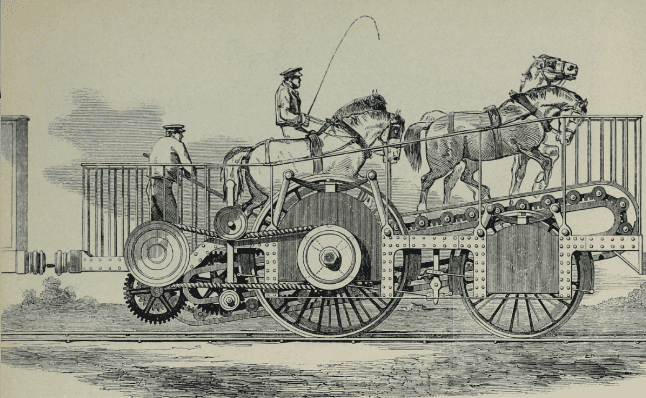
Now that most of the civilised world is busily seeking ways of conserving energy, how about this? The accompanying illustration, taken from the Illustrated London News for June 1850, shows the Impulsoria. What happened to it on the way? It seems incredible that such an invention came to naught, yet how many people of today have heard of it? Perhaps, like so many other brainchildren of the past, it was smothered in infancy by vested interest in rival projects.
The steam engine had been invented some years before, and the country was already being criss-crossed by metal rails. There was a seemingly un-ending supply of coal and coke for the “puffing billies” of the time. The scene has changed. Our trains are run on that precious stuff, oil, and we are at last realising that there must come a time when we shall have used up (some might say squandered) the oil and coal laid down so many millions of years ago.
From the history of steam through to 21st century rail transport news, we have titles that cater for all rail enthusiasts. Covering diesels, modelling, steam and modern railways, check out our range of magazines and fantastic subscription offers.
Even if the limit of speed to be obtained from such a machine as this was 60 miles an hour, it would save a great deal on heavy goods transport—and the time may well come when we shall look on this as a very fair speed, indeed. Is it too much to imagine that we may at some time in the not too distant future be forced to go back to that old measure, those two words which we use so often without a thought as to their meaning…Horse power?
The engraving is such a clear one that I should imagine that any engineer could turn out a working model. The following is taken directly from the article which appeared with the drawing:
“This ingenious means of applying animal power to the working of railways, so as to supersede the costly locomotive engine, has lately been invented in Italy, and exhibited experimentally upon the South-Western Railway.
“It consists in introducing the animals into a kind of coach, called Impulsoria, by which they transmit their acting power to the leading wheels. This transmission is conveyed by a very simple means, rendering useful both the driving power of the animals and their own weight. The horse being thus introduced into the Impulsoria, is placed upon a perfect rectilinear ground, or platform, turning so easily that the animal, which is yoked to the shafts, when it walks, does not itself advance;
but, what amounts to the same thing, the platform itself is pushed backwards. By this artificial ground platform is moved a tree, armed with a pulley, from which by means of a rope, the motion is conveyed to the axle-tree of the leading wheels.
“The varying proportions between the diameters of the pulleys give different degrees of speed. The horses are worked always at their usual pace, whilst the new locomotive will be able to run at any requisite speed at six miles an hour, without ever altering the walking pace of the horses, which are inside the Impulsoria, as on the floor of a room, sheltered from the weather.
“The importance of introducing the horses into the carriage to get more speed from the surplus of the acting power, has long been thought of, and the principles has been attempted in England, France, and Italy, but hitherto without success. The new machine, whose inventor is Signor Clemente Massarano, from Piedmont, has been brought to England from Italy and deposited at the Nine-Elms Terminus of the South-Western Railway, where it may be seen working on the line.
“It has been made for two horses only, and they work it very well. More than thirty waggons have been experimentally drawn by it up the very inclined line of the station. It is calculated that an engine of four horses will run at a speed superior to that of a steam engine.
“The Impulsoria runs either way, like a steam engine, but the driving horses do not change direction or movement, they can be instantly stopped without stopping the machine, and the machine can likewise stop the platform, with horses continuing to walk on the platform, without transmitting motion to the leading wheels.
“By the simple manner by which the horses exercise their moving power on this machine, they can easily work the usual time (commonly about eight hours a day). During these eight hours, the Impulsoria can run at least over thirty miles eight times; and as four horses do not cost much more than two shillings each per day, it would compare very favourably with the cost of coke, at sixpence each mile run. Such economy is of the utmost importance to the numerous interests engaged on the railways, subject to enormous working expenses.
“According to the Statements of Dr. Lardner in his book ‘Railway Economy,’ the locomotive power and rolling-stock absorb more than half, and often four-fifths, of all the working expenses. The principal advantage of the new machine will be to afford very cheap locomotion on all branch lines, thus extending the advantage of the railway to localities hitherto impracticable from the expensive moving power.”
How many stations that have been closed in recent years could have kept a useful service? How many men would love to have charge of those lovely shire horses, and wouldn’t we get back some of the magic of “watching the trains go by”?
This article is available to subscribers of The Railway Magazine, along with every article from issues dating back to the 1800s! To subscribe, visit https://www.classicmagazines.co.uk/the-railway-magazine