Chris Gee recalls seeing his first High Speed Train on August 2, 1980, during a family journey to Newquay. This archive-style personal reflection charts his early impressions, later encounters, and a final farewell to the iconic InterCity 125 in its original blue and yellow livery.
First Sight – August 2, 1980
The iconic HSTs were much maligned in the days when they were replacing Class 55s, 45s, 50s and 47s off top-link InterCity turns, but time is a great healer and now they too are on the way out. Chris Gee recalls his first, and probably last, blue and grey InterCity 125.
August 2, 1980 – the day I saw my first High Speed Train. I can well recall that day, three months after I’d started spotting. We were on our way to Newquay for a family holiday. We didn’t have a car back then, and with my dad working on the railways, we travelled down by train from Manchester Piccadilly to Par and changed onto the branch line multiple unit for our onward journey to Newquay. I can remember, as we crossed the footbridge to head from the Down platform to the branch platform at Par, this magnificent train arrived on the Up into the station. And it emphatically announced its presence.
From the history of steam through to 21st century rail transport news, we have titles that cater for all rail enthusiasts. Covering diesels, modelling, steam and modern railways, check out our range of magazines and fantastic subscription offers.
First Impressions
I knew instantly what it was – I’d seen pictures in my Ian Allan book. While they’d clearly been on the network for four years by that stage, this was my first sighting, and I will always remember it… the sound as it started and accelerated away, and the look – that blue and yellow livery that so well suited the class. It’s the best livery it’s carried, in my opinion; I think because that was how it was designed to look, to suit the body profile. Livery and profile were designed together. Any colour scheme that followed has been forced to fit.
I’d only been spotting around Manchester and the North West for that first three months of the hobby, and the InterCity 125 – so proudly carried on the power car bodyside – was a Western or Eastern Region thing and I hadn’t ventured that far by that stage. They would quickly become familiar, though. Soon after returning from that holiday, we did the round of the London stations and I would see them at Paddington and King’s Cross, though Deltics, 50s and 47s were still commonplace and very much my favourites.
Works Visits and Early Overhauls
My first visit to Crewe Works on February 28, 1981, would give me an opportunity to see HST power cars being built and in the paint shop, ready to receive that striking livery. At the end of the same year, a visit to Derby Works in the snow on December 12, 1981, would reveal some of the early examples already under overhaul!
And despite the fact that they were ousting more interesting diesels from the East Coast and Great Western Main Lines, I still found them exciting – iconic, even. They really are deserving of that label. They looked great and sounded great, though they most definitely didn’t smell that great when braking hard!
Taking Them for Granted
Ironically, for a train that made such an early impression on me, once I’d classed them, they became just part of the background as I pursued older locomotive types, whether it be for haulage, spotting, or photography. I think I stopped paying them attention, despite acknowledging their undoubted role in reviving the fortunes of the railway and despite being such a design and engineering classic.
Railway photography for me is about two things: a record for capturing a point in time to preserve a memory and an art form to create a great-looking image. Sometimes for me that is to recreate an essence of how things used to be. I’m always looking out for a composition that takes me back to when I was young, particularly the early 1980s. I like the challenge of capturing an image that looks almost like it could have been taken in the past. This is hard because modern details creep into the scene. It requires a suitable subject, an appropriate backdrop, often some tight composition to exclude modernity, and some compromises. It’s rarely going to be a perfect recreation of the past, but it is great fun trying to be disciplined to avoid modern giveaways.
The Farewell Tour
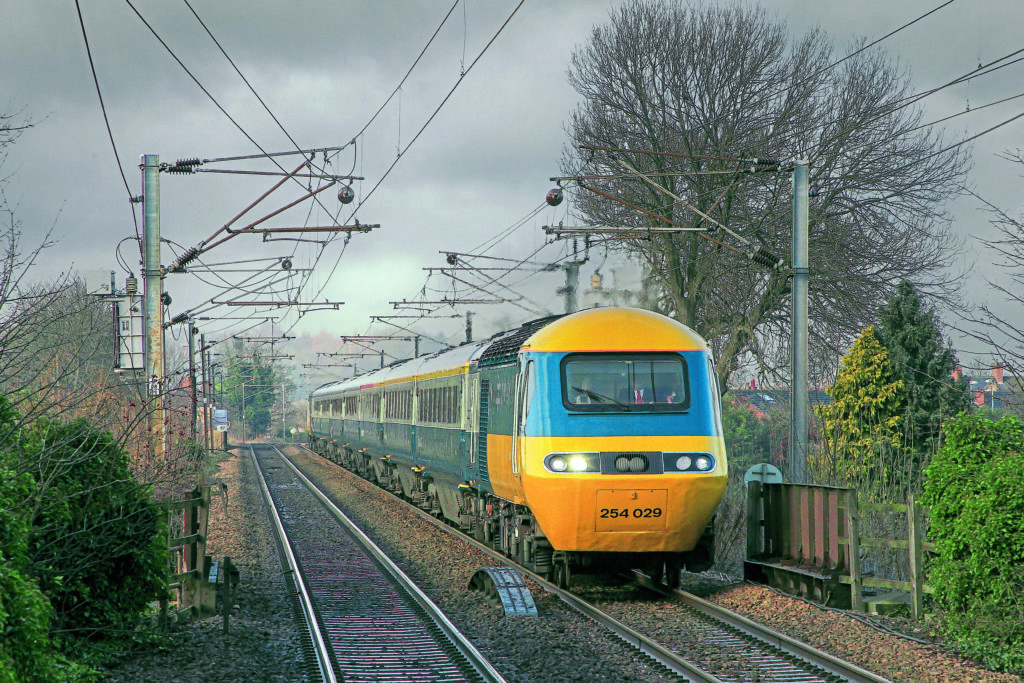
That was, of course, until near the end, when, as is the way with this hobby, things start to disappear and dwindle in number, and you realise you’ve taken these things for granted. So, towards the end of their service on the East Coast Main Line, I started to take more notice, and this was particularly the case when LNER re-liveried a full set in that original iconic blue and yellow, with blue and grey trailer cars. Full credit must go to LNER for that vinyl wrap – for doing the whole train and not just the power cars. It wasn’t in service for long in that livery, so I made an effort over two days to seek out the ‘Let’s Go Round Again’ farewell tour.
Having grown up and gone on to enjoy a long railway career, including being responsible for operations around Leeds and York, it was a pleasure to spend some brief time in the company of this design classic on my patch, a train that made an impression on a young lad who was then inspired to go on to become a railwayman.
December 21, 2019
With power car E43112 leading and unseen W43006 trailing, the fully re-liveried HST set approaches Sandal & Agbrigg station on December 21, 2019, with 1Z43, the 11.01 Leeds-King’s Cross. Or have I momentarily slipped back in time to that first year in the hobby when this iconic train grabbed my attention wherever I saw it?
This article first appeared in Railways Illustrated Magazine. To subscribe for more great news and features please visit HERE