This round-up of preservation engineering updates is drawn from a recent issue of Railways Illustrated edited by Pip Dunn. It summarises restoration, maintenance and operational work currently taking place on a wide range of preserved diesel locomotives at locations including Williton, Bury, Loughborough, Kidderminster, Bitton and Carnforth. The updates cover ongoing mechanical repairs, overhaul progress and operational status across several classes within the UK heritage railway sector.
08401 – Williton:
The loco is now on No. 2 road outside the loco shed while the team work on the detailed planning for reinstating the vacuum brakes to make it dual-braked again. In parallel, the sourcing of the remaining few special parts, vacuum chambers, door panels, pipework and so on is ongoing.
D4107 – Williton:
The Class 09 is currently outdoors on No. 1 road but will soon move into the shed and be positioned under the crane so its Westinghouse 3CV50 compressor can be removed to give access to the main generator. This level of disassembly is necessary to allow access to the generator so that the brush gear can be cleaned and examined and new brushes fitted. While the loco is inside the shed, a few repair tasks will be undertaken in and around the cab to make it fit for another year of service before it can be stopped for a cab roof repair (which is a significant task on a loco of this type), by which time 08401 should be dual-braked and ready to take over as Bishops Lydeard station pilot.
D9518 – Williton:
More progress is being made on the Class 14. The battery box covers have now been refitted, and the wiring and pipework is progressing in parallel with the engine rebuild.
From the history of steam through to 21st century rail transport news, we have titles that cater for all rail enthusiasts. Covering diesels, modelling, steam and modern railways, check out our range of magazines and fantastic subscription offers.
D8233 – Bury:
On Christmas Eve, Santa delivered at Baron Street Works by moving D8233 from its usual location tucked well into Road No. 4 and onto the jacks on Road No. 2. It’s now been lifted and the temporary DMU bogies have been removed from the loco.
With the underside now fully accessible and exposed, the final areas of the underbody prepping and painting, as well as the remaining air pipe system restoration, can be completed.
The bogies are very close to being completely restored and will soon be ready to move back under the Class 15; hopefully in the first quarter of 2026.
D8568 – Kidderminster:
The Class 17 returned to action at the SVR’s December 29 diesel day. As it has no train heating, it was used in tandem with steam locos or hauling DMUs. These were its only passenger turns of 2025, and its first in its new livery with full yellow ends.
D5185 – Loughborough:
The Class 25 is inside the shed still waiting for an appropriate day to have the pistons lifted out, so more work on cutting out metal and finding the rot has continued. Once all the areas that require new metal have been identified, fabricated pieces will be made and welded into the body and frame.
The group’s donations page is still open, with all funds going straight to the locos:
www.crowdfunder.co.uk/p/northampton-type-2-group
27056 – Loughborough:
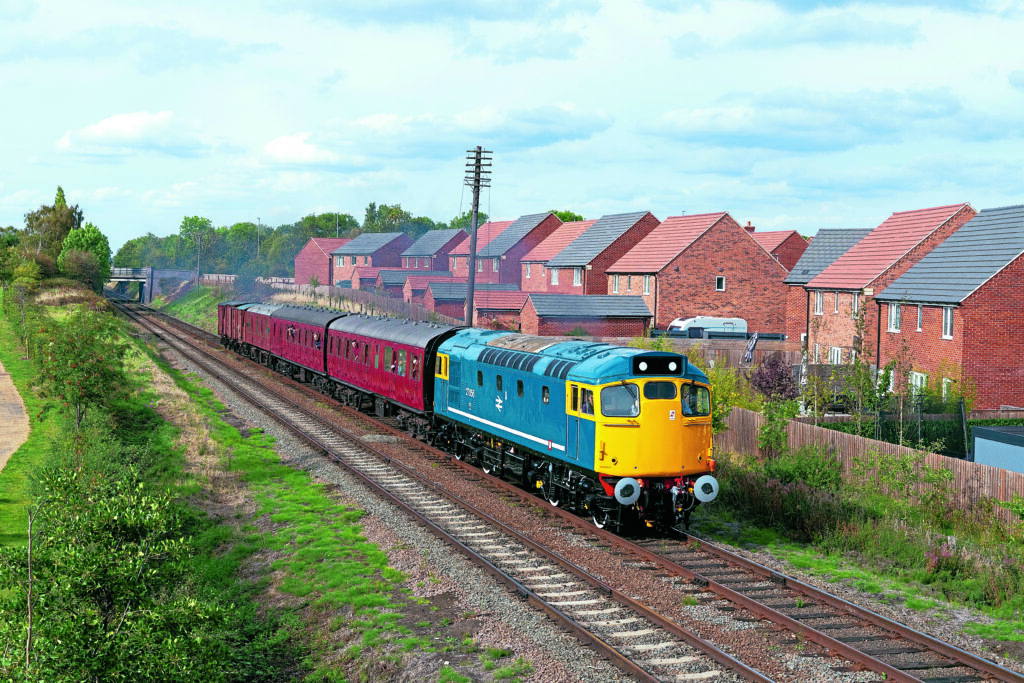
During the last turn of the year for the 27, the overload trip on No. 3 traction motor activated twice. This did not stop the loco finishing its turn as the motor was electrically isolated on the cubicle.
The owners took advantage of a quiet New Year’s Day at Loughborough to get the loco over the pit to begin the investigation. After a visual inspection of the motor, with no signs or smells of distress, an insulation test of the motor was conducted, which returned a healthy figure of three megaohms. The team began to inspect the overload itself, and it was noted that its physical operation appeared to be different to the others. This now leads them to believe the overload itself has failed internally and will need removing to ascertain what has happened.
On the same day, the lighting circuit control switch also decided to fizzle to failure, meaning no lighting at all on the loco. The switch was removed and stripped to reveal a fascinating design inside, with roller pins forming contacts between the multiple layers of the switch. This allows the switch to reduce the arc when braking under DC current.
One of the silver-plated copper pins was so badly worn that a new one has been made to replace it, and the whole switch was cleaned in an ultrasonic bath. The switch now reads good under test and will be refitted.
The 27 is not expected to run again until March/April. Although the loco has fulfilled its turns and more with the added running in December, it has not been without issue. The group can now focus on finishing jobs from the restoration and faults operationally.
31101 – Bitton:
The loco continues to receive attention to the rebuild of the power unit and cab and control cubicle rewiring. Hopefully, the power unit should see much progress later in the year as the hardest tasks have been completed; it’s now just a matter of bolting everything back on.
31130 – Bitton:
The Class 31, which has performed almost faultlessly since its return to traffic in 2000, has not been in the best of health just recently, with water ingress into the main reservoir system causing no end of headaches over the past few months.
Unfortunately, this came to a head just before the Santa Season with a large and noisy air leak emanating from the area behind the battery boxes. A quick inspection over the pit revealed no obvious location for the problem, and as the loco was due to go on standby for the Christmas period, it was decided to leave well alone as although the leak was severe, the loco could maintain its 120/140psi cycle with both compressors running. That meant that it could only act as a Thunderbird to assist a failed train in the event of a failure.
The new year has seen the team look further to diagnose the fault. Initial thoughts were that it was a union or air tank problem just behind the right-hand battery box, but that theory was dashed when it was found that the offending tank was actually behind the front one, above the fuel tank and impossible to get at.
After much deliberation and despair, it became apparent that the team would have to bite the bullet and somehow remove not only both side battery boxes but the fuel tank as well – complete with its 250 gallons of diesel.
However, ably assisted by volunteers at the AVR, the group is now part-way through this and both battery boxes are off, with work in hand on removing the fuel tank and its associated pipe and drain connections.
With the loco stopped, long overdue engine work will also be undertaken, as well as oil leaks, which have now reached an unprecedented level. This will probably take the form of a top end overhaul on three cylinders, the middle of which appears to be the main culprit.
31210 – Ruddington:
Along with 31235, the two Class 31s were due to be moved from Ruddington to the Nemesis Rail site at Burton to allow them to exchange bogies to give 31210 the superior wheelsets and allow it to return to traffic. 31235 is then expected to be disposed of. Hanson & Hall was contracted to move the locos using 50008 Thunderer.
D6566 – Williton:
The Class 33 is outdoors and had one of its vacuum exhausters removed for overhaul. When the shed is available, it will move indoors so its leaking engine room roof can be removed and repaired.
D7017 – Williton:
The Hymek is receiving some light maintenance and undergoing internal cleaning. The loco will undergo ultrasonic axle testing at a date to be arranged, in preparation for some visits to other railways.
D7018 – Loughborough:
The loco was employed on the Great Central Railway’s Nightrider trains on New Year’s Eve, meaning it saw in 2026 working a passenger train. The headcode display read 2O25 at the start of the turn and was changed to 2O26 as midnight came.
40106 – Bury:
The loco was fit for the start of the Christmas season and worked several days of Santa specials and finished the year operating the diesel diagram on December 27 with 50015 Valiant.
Unfortunately, 40106 suffered a boiler failure in early December and is currently ‘no heat’ and will remain so until further notice, although the CFPS says it is expected that the boiler should be up and running again the first quarter of the year.
40106 will be taken out of service in April to undergo bodywork repairs and a full repaint into the 1980s livery of BR green with full yellow ends and TOPS numbers, the look it had when it attended the Rainhill Festival that year.
The loco desperately needs bodywork repairs to help preserve it for the future. It is hoped that the loco will make its ex-works debut at the ELR summer diesel gala in July, where it will hopefully work alongside D345.
40135 – Bury:
Work will continue with the end-to-end restoration of 40135 going into the spring and summer. Its generator is now fitted to D345, following its failure at the end of 2024, with the defective generator from D345 currently being assessed at Bower’s in Derby.
D345 – Carnforth:
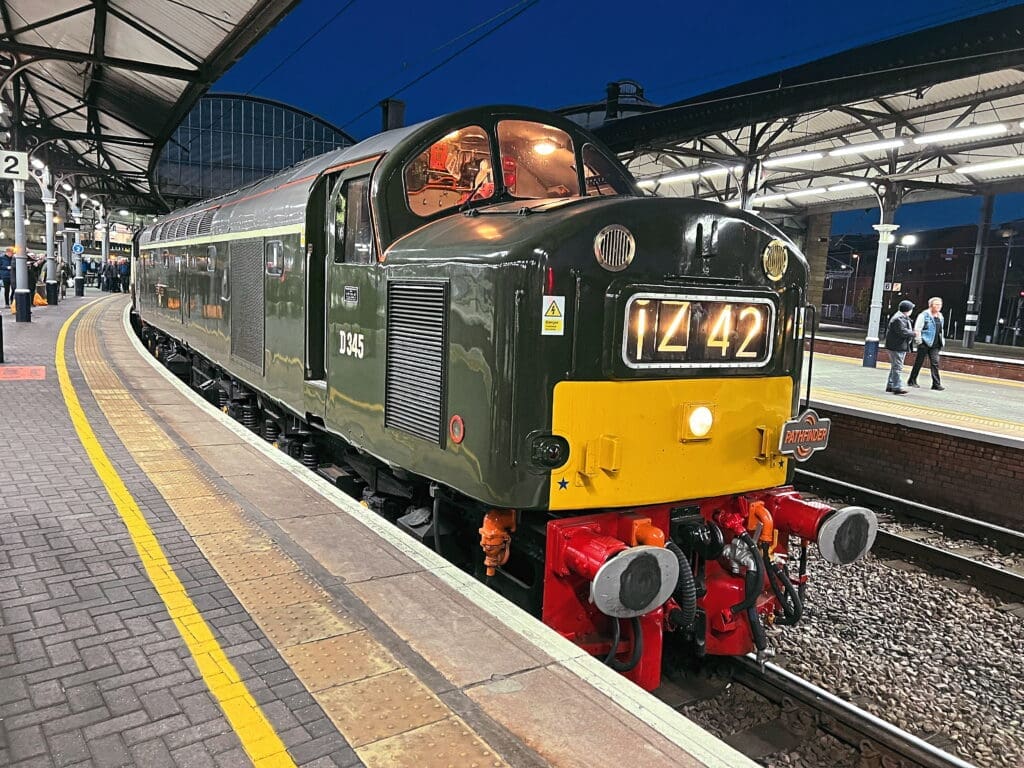
During January, the CFPS’s main line-registered loco was expected to have its engine run up for the first time in a while. Further testing will then take place with the intention of having it main line-ready by March 1.
The CFPS’s insurance is renewed annually on the same date and West Coast Railways is going to align the rest of its main line certification. This means that the majority of D345’s maintenance can be done out of season. Up until now, many of the key dates occurred during the charter season, meaning it had to be taken out of service too frequently and the CFPS was constantly working against the clock to ready it for its next main line work.
D345 will remain Carnforth and the CFPS will sub-contract its safety-critical maintenance to WCR.
The CFPS is still finalising the arrangements with D345 but remains hopeful that 2026 will be a good year on the main line for its locomotive.
47077 – Grosmont:
The DEPG’s loco is on long-term hire to the North Yorkshire Moors Railway but has been stopped because of an issue with its triple pump: an electrical machine that is a combined water pump, oil pump and fuel pump, all driven from one big DC electric motor.
The spare triple pump at Williton needed an overhaul and has now been stripped so the motor can be sent out for reconditioning before being sent to the NYMR for fitting on the 47. This work was planned for completion by the end of February.
47715 – Chinnor:
The loco was brought into service for a controlled run-up and full systems check. Keeping heritage locos operational through winter is challenging at the best of times; however, those built with engineering integrity respond well to regular running, movement and inspection.
Recent engineering tasks have included lubrication of all grease points and the replacement of defective grease nipples, the application of rust inhibitor within the brake system, and a full air system drain-down to remove accumulated moisture.
The engine has been run-up with functional checks and fluid levels checked and topped up as required. The loco undertook a controlled movement to monitor for any abnormal noise or vibration while the battery has been charged and checked over. There has also been some targeted corrosion treatment to the internal roof area.
50007 – Kidderminster:
Despite a working party arriving at Kidderminster in freezing conditions, maintenance is far easier and enjoyable to complete inside the warmth of Kidderminster TMD.
Last year, the Class 50 Alliance team replaced all the cylinder liners and renewed all of the piston rings and big end bearings on B bank on 50007; this year will see the same work undertaken on A bank.
A start was made on removing all of the split pins on the big end bolts, followed by the removal of A1/2/3/4/5/7/8 pistons; A6 was left as this was worked on some time ago after a piston failure.
After a long, hard day, all seven pistons were removed. A7 was found to have a severely damaged piston; the cause would be the top compression ring breaking and then coming apart.
Taken from a recent issue of Railways Illustrated magazine. To subscribe, please visit: https://www.classicmagazines.co.uk/railways-illustrated