An extract (verbatim) from a March 1983 issue of The Railway Magazine detailing cement traffic operations involving Ribblehead, Clitheroe, and associated routes. The text outlines freight movements, locomotive use, and operational arrangements as described at the time.
Introduction
ROBERT H. FOSTER RECOUNTS A REGULAR BULK TRAFFIC TO THE NORTH-EAST AND SCOTLAND
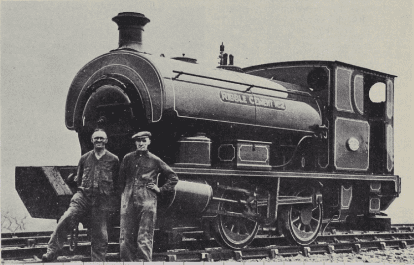
NOW part of Rio Tinto Zinc Corporation plc, Ribblehead Cement Limited has been manufacturing cement at its works near Clitheroe in Lancashire since 1937. The works is situated at the short branch which forms a private siding running from Horrocksford Junction, on the Blackburn – Hellifield line, and is almost one mile long. There is a passing loop just beyond the junction where BR locomotives attach to and detach from trains. Beyond that the line splits into a number of sidings and loops within the works itself. Three privately-owned shunting engines were based there, including an ex-BR Clayton type ‘1’, No. D8568, though this has been phased out of service and sold to the Diesel Traction Group, for use on the North Yorkshire Moors Railway.
From the history of steam through to 21st century rail transport news, we have titles that cater for all rail enthusiasts. Covering diesels, modelling, steam and modern railways, check out our range of magazines and fantastic subscription offers.
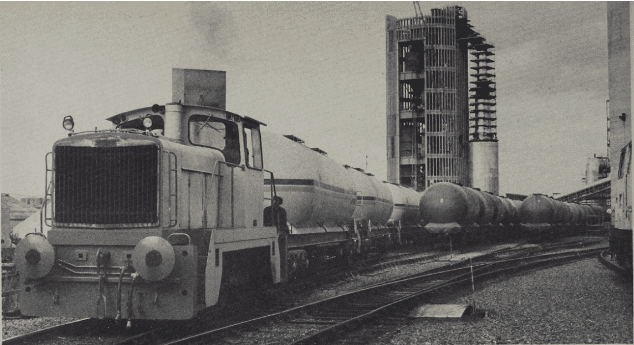
At one time only bagged cement was carried by rail, but during recent years considerable tonnages of bulk cement have been placed on BR as distribution depots have been established. It is good to see that rail accounts for a significant share of the outgoing traffic, amounting to 25-35 per cent. of bulk (that is, excluding bagged) cement. It is expected that this share will increase in the future, as it is company policy to use rail transport where possible.
Most of the cement is carried in block trains. An average of four trains depart each week for the North-East, consisting of two to Newcastle (Railway Street) and two to Middlesbrough (Forty Foot), where Ribblehead Cement has its own distribution depots. These trains leave Clitheroe at 21.19 on Mondays to Thursdays and travelling via Hillifield (reverse), Skipton and York, arrive at Newcastle at 05.10 or Middlesbrough at 06.25 the following morning in time to be discharged at the beginning of the day’s work. The set works back to Clitheroe over the same route overnight to return in time for loading the next day.
Return Working and Train Operation
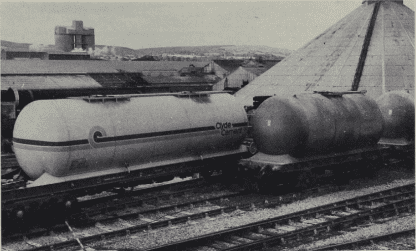
Two sets are required to cover the four weekly workings to the North-East (gross laden weight) four-wheel cement tank wagons with a maximum speed of 60 m.p.h. Each train has a gross weight of 1,020 tonnes and a payload of 740 tonnes. Four wagons are kept as spare. The 44 wagons were built by the Standard Railway Wagon Co. Ltd., at Heywood, Manchester, and are owned by Ribblehead Cement. Loading is performed by gravity from overhead silos positioned above the tracks. Two such silos have recently been built at the works. Wagons are discharged at the other end two at a time under pressure.
Mention should also be made of a Ribblehead Cement depot at Hexham, on the Carlisle – Newcastle line. This was the firm’s first incursion into the North-East and was prompted by the construction during the 1970s of the nearby Kielder Reservoir. The depot has now closed following the establishment of the one at Newcastle, which with Middlesbrough depot serves the centres of population in that part of England. Both depots are equipped with the help of Government Section 8 Grants.
Additional Traffic and Locomotive Use
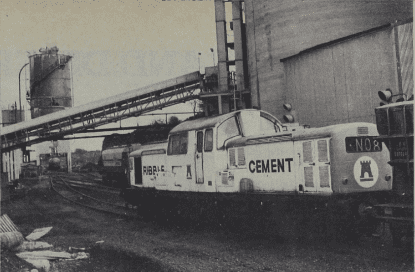
Ribblehead Cement also sends out occasional trains, which run as required, comprising vacuum-braked Presflo wagons to the Selby Coalfield (Gascoigne Wood) and to other northern destinations including the BR Chief Civil Engineer’s Workshops on Crewe and Newton Heath in Manchester. The Presflos can also be used as supplementary to other block trains. They are BR-owned and a pool of 48 is available for use by Ribblehead Cement. However, their use is likely to diminish soon, because BR intends to withdraw vacuum-braked freight vehicles from May 1983—except for movements in block train loads.
The other regular flow of traffic from Ribblehead Cement is a twice-weekly train from Clitheroe to the works of Clyde Cement Limited (a subsidiary of the Ribblehead Cement) at 17.30 on Tuesdays and Thursdays and reaches Mossend about midnight, from where it continues next morning to Gartsherrie (just off the old Motherwell to Stirling ex-Caledonian main line) and arrives at about 06.30 for unloading. The empty train works back from Gartsherrie at 00.05 on Tuesdays and Thursdays, returning to Clitheroe at 07.23, from where it leaves again loaded the same evening.
This train conveys 18 bogie wagons which were recently built, also by the Standard Railway Wagon Co. Ltd., and are leased through Railease Limited. The bogie fleet comprises tank and hopper wagons which convey cement and cement clinker respectively, the proportion depending on the requirements at Gartsherrie. The wagons have a g.l.w. of 88 tonnes and tare of 24.5 tonnes. They are likewise loaded by gravity, and unloaded by pressure in the case of the tank wagons and by gravity in the case of the hopper wagons. They are air-braked—and in fact are the first single-pipe air-braked freight vehicles built in the UK to operate on BR—and have a maximum speed of 60 m.p.h. Pending the completion of suitable discharge facilities at Gartsherrie, the hoppers have been detached at Mossend and worked separately to Cadder Yard (on the Edinburgh – Glasgow main line), the contents there being transferred to road vehicles for the onward journey to the cement plant at Gartsherrie. This is likely to cease before the end of last year, whence the whole train will terminate at Gartsherrie.
With 18 wagons the total train weight is 1,584 tonnes, and this constitutes the second heaviest train over the WCML. The train is double-headed, normally by two class ‘37’ locomotives from Eastfield and Motherwell depots. Electric locomotives do not have the adhesion capability for tackling the southern ramps of Shap and Beattock (although the steepest part of the journey is in fact Wilpshire bank, between Clitheroe and Blackburn).
At present the bogie wagon fleet consists of 26 tankers and 16 hoppers, but an order has been placed with the same manufacturer for a further 10 tankers. It is anticipated that in due course the total train flow will increase to three or four trains per week and it may eventually rise still further. Ribblesdale Cement aims in future to increase the carrying of cement, particularly to other destinations in Scotland, as rail is very competitive over such distances. A depot was opened at Craignecans, Aberdeen, in May 1982, and tankers travelling thence run in the morning Mossend – Aberdeen Speedlink service. Further depots in Scotland are a possibility.
In conclusion, I should like to thank Ribblesdale Cement Limited and British Railways for their help in preparation of this article.
This article is available to subscribers of The Railway Magazine, along with every article from issues dating back to the 1800s! To subscribe, visit https://www.classicmagazines.co.uk/the-railway-magazine