An extract from the January 1956 issue of The Railway Magazine describing passenger and goods services, station layouts, motive power, and traffic patterns centred on Tunbridge Wells West. The article records contemporary operations, routes, rolling stock, and infrastructure as they stood in the mid-1950s.
IN the Tunbridge Wells area of the Southern Region of British Railways there are two combined passenger and goods stations, Tunbridge Wells West and High Brooms, and one purely passenger and one exclusively-goods station, Tunbridge Wells Central and Tunbridge Wells Goods respectively; all four are under one stationmaster. The two main passenger stations are Central, on the former South Eastern London-Hastings line, and West, originally terminus of the London, Brighton and South Coast Railway and later connected to the S.E.R. route by a single-line spur.
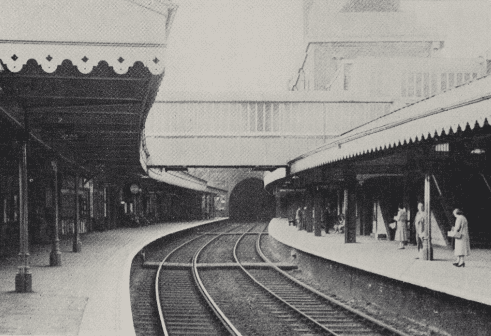
The Central station is situated near the centre of the town, and is confined in very small space between two tunnels and by important roads. Although—opposed to the West station—it is used almost exclusively by passengers travelling to and from London, including a large number of season ticket holders, it has room for only two platforms, one each for the up and down roads, with an emergency crossover. Apart from trains that also call at the West station, it serves only the London-Hastings-Bexhill traffic.
From the history of steam through to 21st century rail transport news, we have titles that cater for all rail enthusiasts. Covering diesels, modelling, steam and modern railways, check out our range of magazines and fantastic subscription offers.
Under the British Railways modernisation scheme, this route is to be one of the first main lines to be worked by diesel-electric multiple units. The present intention appears to be that these trains mostly will be six-coach sets run separately or in pairs, though there may be some smaller sets also. It seems likely that in the up direction, as an hourly service, except during the rush-hour periods, six-coach sets will leave Hastings successively as stopping and fast trains, so timed that they will be coupled at Tunbridge Wells Central and proceed to London as a twelve-coach train. Similarly in the down direction, twelve-coach trains will be split at Central, the leading portion proceeding fast to Hastings, followed by the rear six coaches as a slow train.
As the platforms now accommodate only eleven-coach trains, they will have to be extended to the portal of Grove Tunnel, south of the station. Other modernisation developments expected are the installation of colour-light signalling in this area and removal of the cross-over at Grove Junction at the south end of that tunnel. At this junction a single-line link to the West station diverges on a 1 in 80 falling gradient.
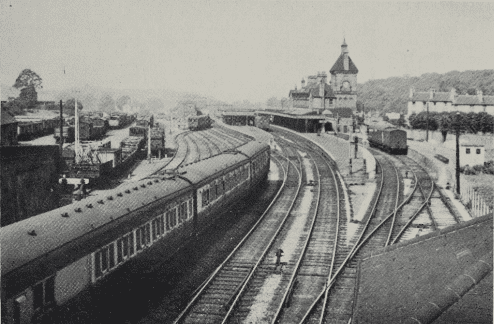
West Station, though it is quite near the celebrated Pantiles, is less conveniently situated than Central and on the outskirts of the old part of the town. A large new estate is, however, springing up beyond it. It is a much larger station than Central, and is self-contained with its own goods yard, motive power depot and carriage sidings. The passenger station has five platform roads, three serving long platforms, two of which are in the form of an island, and the two others bays used by short trains.
The reason for this extensive layout is that the station serves no fewer than six different routes, three of them bifurcating at or near Groombridge, three miles distant, and two at Eridge, five miles away. As from the introduction of the 1955 summer timetables, the services between London and Tunbridge Wells West were entirely revised and the number of passenger trains using this station increased.
On a normal mid-week day there are 66 departures and 70 arrivals, or 136 trains in all. There are also nine goods trains, five in and four out daily. During the 18 hr. between 6 a.m. and midnight there is, on an average, a passenger train either arriving or departing every eight minutes.
There are a few through trains to London via Route 1, but most terminate or originate at Oxted, running as a shuttle service from and to West Station, but connecting at Oxted with Route 2 through trains via East Grinstead or London trains starting from or terminating at East Grinstead. Before July, 1955, more trains ran through to and from Three Bridges, but now there are only two each way; the service beyond East Grinstead is, however, maintained by the shuttle service to Three Bridges connecting with the West Station-London trains and vice versa at East Grinstead. On Route 4, one or two trains run to and from Uckfield or Lewes only, and there is a complicated series of interchange services at Eridge between trains both ways on Routes 4 and 5 and through trains from and to London and Brighton (via Uckfield), and Eastbourne (via Heathfield), which are super connections between Ashurst and Eridge. Trains on Route 6 mostly come from or go to Tonbridge, though a few originate or terminate at Sevenoaks. Most of the trains go through to, or come from Brighton.
The motive power depot (code number 75F) has a four-road terminal-type shed, but is only a small turntable. The shed is at present being rebuilt with higher walls and pre-fabricated Warren-truss roofing girders spanning all four tracks. All goods trains are worked by “foreign” engines, stationed at Tonbridge, Three Bridges, Brighton or elsewhere. Consequently the 25 engines at 75F are all passenger types. The preponderance of class “4” 2-6-4 tanks is remarkable, there being 14 of these, eight standard and six of the London Midland type. There are also two class “2” 2-6-2 tanks, four 0-6-2, and six Western class “4” “M7” 0-4-4 tank engines. The latter have been imported mainly to work the shuttle trains to and from Oxted. Visitors are mostly Brighton 0-6-0s, various Southern 4-4-0s, and standard class “4” 2-6-0, and less often engines such as ex-S.E.C.R. “H” class tanks. The through London trains and some others notably a few to and from Brighton, are composed of modern Southern corridor stock, but most other trains are of the South Eastern non-corridor stock (except in part of the lavatory vehicle stock), or pull-and-push sets.
The station yard is controlled by two signalboxes, one at the west end with 45 levers which also controls roads to the locomotive yard and carriage sidings, and the other at the east end with 28 levers. The single-line section between the latter box and Grove Junction is worked by the train staff and ticket system. The double-line approach for down trains to the west end of the yard is on an 88 gradient right up to a point well within the home signals, which are 368 yd. from the outermost facing points; similarly steep gradients continue onwards towards Grove Junction. No very heavy trains are therefore, to be seen at the West Station, eight corridor coaches being the maximum passenger train load. However, it is quite a busy centre for light short-distance traffic.
Taken from the January 1956 issue of The Railway Magazine. You can access ALL the archive, dating back to the 1890s, if you subscribe to The Railway Magazine, here